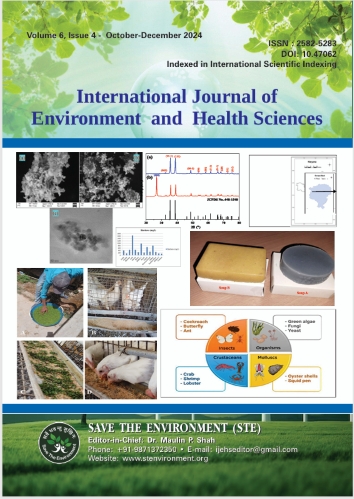
INTERNATIONAL JOURNAL OF ENVIRONMENT AND HEALTH SCIENCES
ISSN 2582-5283
DOI Prefix: 10.47062
ISSN 2582-5283
DOI Prefix: 10.47062
Abstract
C.M. Balamurugan, A S Jagadheeswari , A. Anandhan and V. Gopalakrishanan
Abstract:
Marine-origin polysaccharides have been used in recent research because they are readily available, reasonably priced, biocompatible, and biodegradable. Since it can be made from leftover marine crustaceans, chitosan is becoming more and more valuable in a variety of applications. The structural component of fungi, insects, and crustaceans, chitin is the second most common biopolymer on Earth, behind cellulose. Chitin can be deacetylated to produce chitosan, a deacetylated derivative of chitin. Because the amino groups that give the polymer its many characteristics are present, it is a functionally versatile biopolymer. Though it has been employed in many industrial applications, biodegradable chitosan soap is one of the more recent uses for it. The properties of chitosan have been enhanced through a variety of techniques, including the use of plasticizers and cross-linkers, the embedding of fillers like fibers, whiskers, and nanoparticles, and the blending of the polymer with other natural and synthetic polymers as well as with natural extracts and essential oils. To get this biopolymer to industrial levels for use in biosoap and bioplastic applications, however, a lot more research is still required. Foamability, Total Alkali, TFM, pH, Hardness, and Antimicrobial are the characteristics of biosoap.
Keywords:
Chitosan
Biosoap
Marine Biopolymer
Biodegradable
Tissue Engineering
- Volume 1 Issue 1( 2019 )
- Volume 2 Issue 1 ( 2020 )
- Volume 2 Issue 2( 2020 )
- Volume 2 Issue 3( 2020 )
- Volume 2 Issue 4( 2020 )
- Volume 3 Issue 1( 2021 )
- Volume 3 Issue 2( 2021 )
- Volume 3 Issue 3( 2021 )
- Volume 3 Issue 4( 2021 )
- Volume 4 Issue 1( 2022 )
- Volume 4 Issue 2( 2022 )
- Volume 4 Issue 3( 2022 )
- Volume 4 Issue 4( 2022 )
- Volume 6 Issue 1( 2024 )
- Volume 6 Issue 3( 2024 )
- Volume 6 Issue 4( 2024 )